The Bulletin of the Atomic Scientists Named Laureate of the Second Miwon Peace Prize
2026.08.04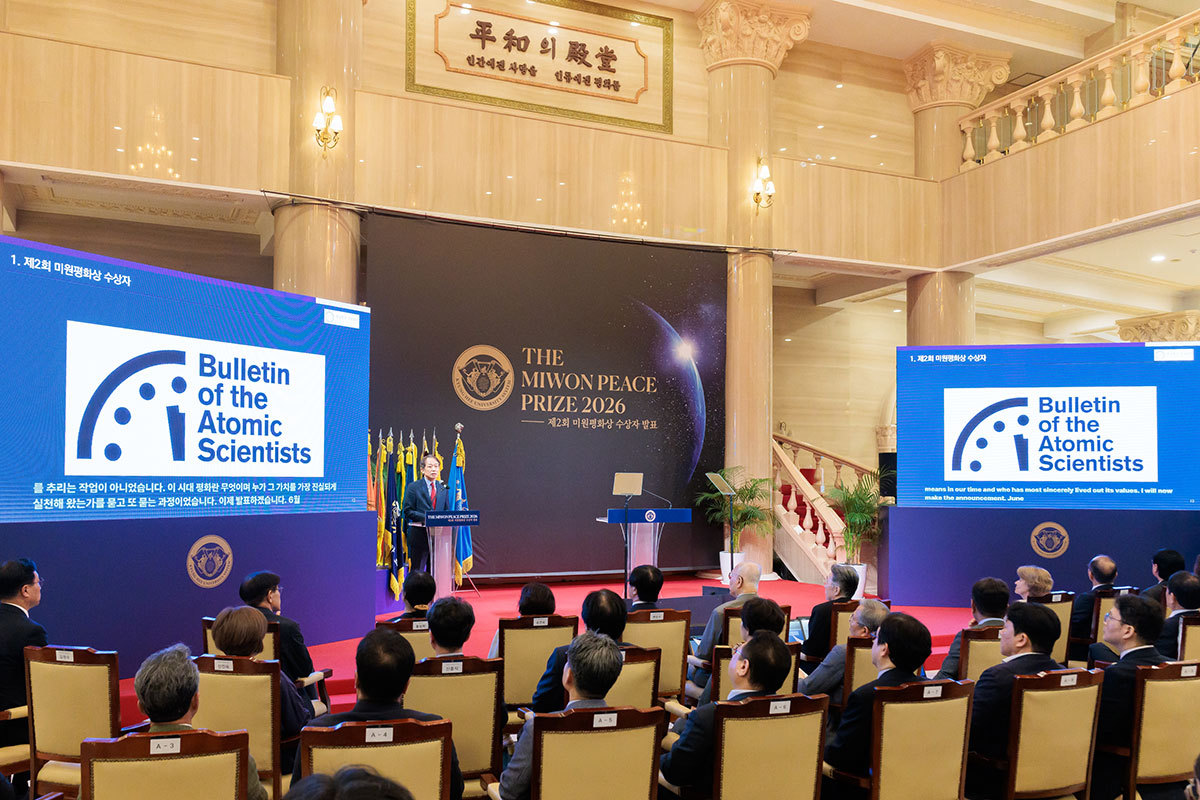
Kyung Hee University System recognizes the Bulletin’s eight decades of translating scientific warning into public action for humanity’s shared future
Award ceremony to be held on September 21, the UN International Day of Peace
The Kyung Hee University System announced on Monday, June 29, 2026, that the Bulletin of the Atomic Scientists has been selected as the laureate of the Second Miwon Peace Prize.
Founded in December 1945 by scientists and engineers who had worked on the Manhattan Project, the Bulletin emerged from an urgent conviction that the consequences of nuclear science could not remain within the scientific community alone. In the aftermath of the atomic bombings of Hiroshima and Nagasaki, its founders sought to bring the ethical responsibilities of science and technology into public debate and to connect scientists, policymakers, and citizens in the pursuit of peace and security.
For more than eighty years, the Bulletin has carried that mission forward. Its Doomsday Clock, created in 1947, has become one of the world’s most widely recognized symbols of humanity’s proximity to catastrophe. By addressing nuclear danger, climate change, biological threats, and disruptive technologies, the Bulletin has done more than warn of existential risk; it has helped create a shared language through which the public and decision-makers can understand those risks—and act to reduce them.
The Kyung Hee University System selected the Bulletin in recognition of this enduring contribution. Although the two institutions have followed different paths, they share a civilizational aspiration: to establish peace as a foundation for the future and to safeguard the conditions for humanity and life on Earth to flourish.
Understanding Interconnection as the First Step Toward Change
The Second Miwon Peace Prize Laureate Announcement Ceremony was held at the Grand Peace Hall of Kyung Hee University. The program included an introduction to the Miwon Peace Prize, a report on the selection process, the official announcement of the laureate, the Selection Committee’s grounds for recommendation, a video introducing the Bulletin, and congratulatory remarks by Chancellor Inwon Choue of the Kyung Hee University System.Chancellor Choue; Irina Bokova, Chair of the Miwon Peace Prize Selection Committee and former Director-General of UNESCO; leaders of Kyung Hee institutions; faculty; staff; and students attended the ceremony. Members of the Miwon Peace Prize Supporters Association in North America and the Kyung Hee International Foundation also joined in real time from the United States. The ceremony was more than the announcement of an award. It offered an opportunity to reflect on the values the Miwon Peace Prize seeks to advance: a critical awareness of the age, a responsibility for humanity’s shared future, and the search for a new path toward peace.
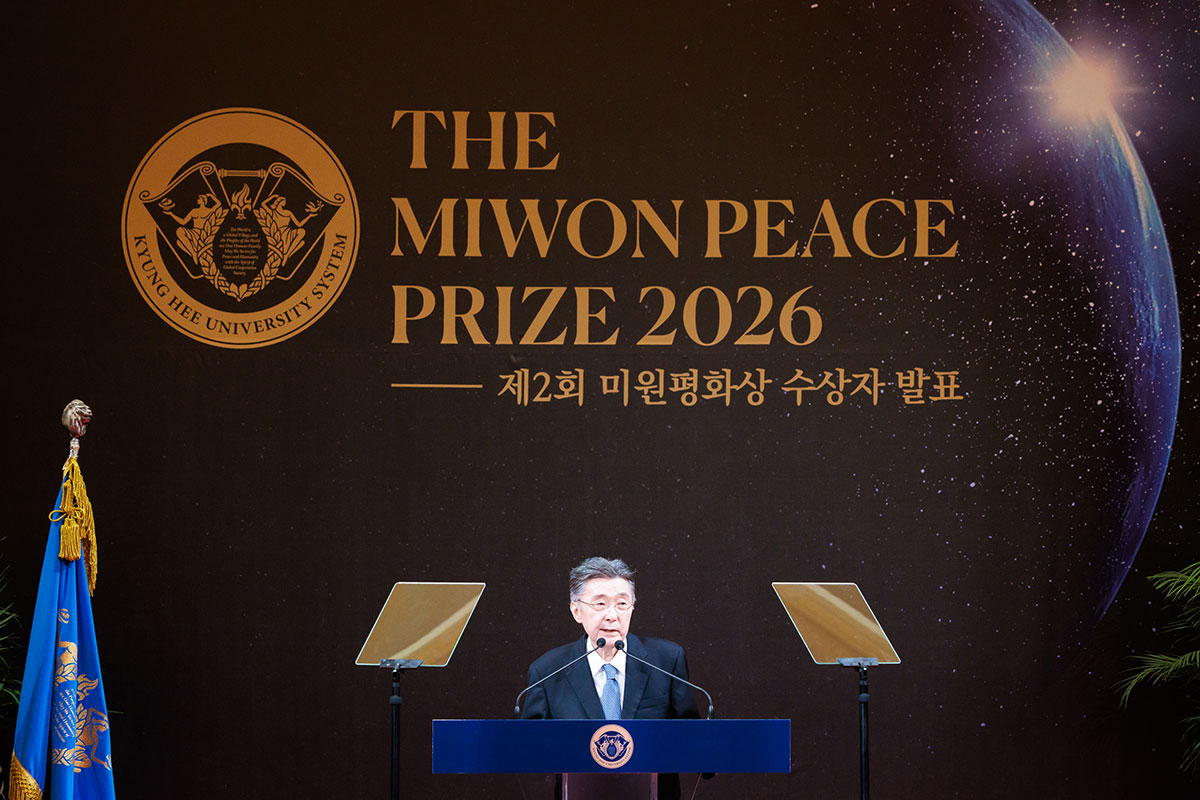
In his remarks, Chancellor Choue said:
The first step toward change is what the Bulletin has already told us. We must understand the reality of the present crisis within the planetary context of interconnection. We should also open a horizon of integrated thought. Such a horizon requires a philosophical framework capable of bringing these dimensions into a coherent whole.
Kyung Hee’s founding philosophy sought holistic wisdom in the deep coherence between two worlds: Juri (主理), the world grounded in the timeless order of nature and cosmos, and Juui (主意), the world arising from our existential consciousness and will to action.
Kyung Hee sought a living forest of wisdom.
It has endeavored to illuminate, through a holistic worldview, the inseparable bond between the profound order of the natural world and the world of human consciousness and its social realities.
He continued:
‘All beings and events in the world are interconnected.’ ‘Through the cosmic dynamics of mutual interaction, regulation and enhancement, all beings move through creation and dissolution toward cosmic harmony.’ ‘When humanity strives to approach the ultimate source of human consciousness and social will, it may be able to write a new history of civilization.’
These are the underlying premises of a world of holistic engagement. To search for that possibility has been Kyung Hee’s history. It is also the guiding narrative of Kyung Hee’s future. This is indeed a day of celebration.
It is a great honor to announce the Bulletin of the Atomic Scientists as the laureate of the Miwon Peace Prize. The Bulletin’s work resonates deeply with the philosophy and practical vision of the Kyung Hee University System.
Unanimous Consensus:
The Selection Committee Recommendation and Board Decision
Established in 2024, the Miwon Peace Prize carries forward the peace vision and civic engagement of Dr. Miwon Young Seek Choue (1921–2012), founder of the Kyung Hee University System. Awarded biennially, it honors individuals and institutions that open new intellectual and practical horizons in an age of transformation, contribute to global peace and cosmic harmony, and offer future generations compelling examples of service to humanity and life on Earth.The nomination process for the Second Miwon Peace Prize began in September 2025. Over four months, 63 candidates were nominated by distinguished figures from academic institutions and civil society in Korea and abroad. The seven-member Selection Committee, composed of internationally recognized scholars and practitioners, held five rounds of deliberation between January and March 2026. After careful review and verification, the Committee unanimously recommended the Bulletin to the Board of Trustees of the Kyung Hee University System. The Board’s final decision in April was also unanimous.
Won-soo Kim, Senior Advisor to the Miwon Peace Institute of the Kyung Hee University System and Rector of the Global Academy for Future Civilizations at Kyung Hee University, announced the laureate following his report on the selection process, saying, “The Selection Committee highly valued the Bulletin’s eighty-year legacy of advocating for peace in the language of science and enabling global citizens and leaders to face the stark reality of our existential crisis. The Miwon Peace Prize seeks to amplify the value of such practicethese efforts and expand international solidarity around it.”
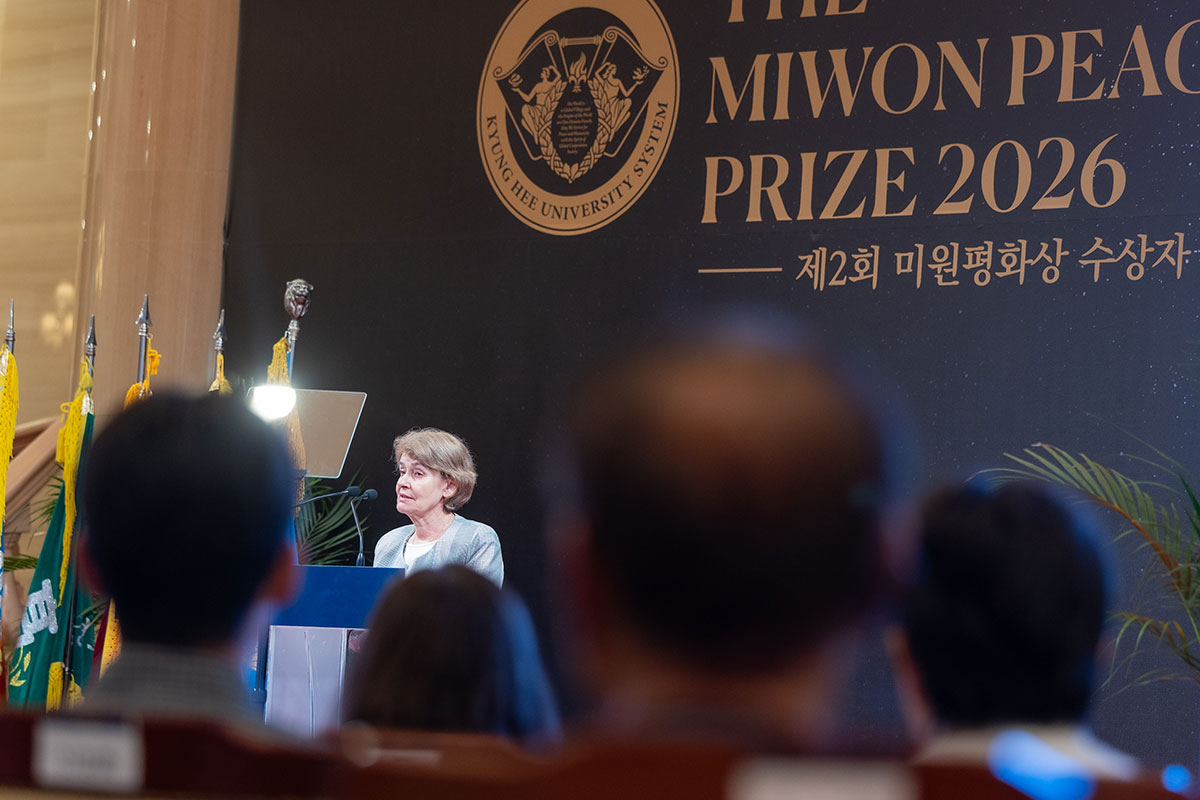
Speaking on behalf of the Selection Committee, Chair Bokova explained that the Committee had looked beyond conventional understandings of peace.
The Committee prioritized candidates who expanded the horizon of peace beyond conventional paradigms. We examined candidates by encompassing various dimensions of human endeavor where peace is pursued, looking most importantly at whether their values and actions were consistently sustained over time. Throughout this process, we repeatedly asked ourselves one central question: “Who is fundamentally transforming humanity’s awareness of existential threats and opening a new path toward peace?” We unanimously recommended the Bulletin, which has represented universal human values with scientific rigor and demonstrated the wisdom and courage to warn humanity before crises reach an irreversible stage.
The Bulletin welcomed the announcement in a statement published on its website. President and CEO Alexandra Bell said the award recognized the organization’s commitment to translating scientific knowledge into action for peace, security, and the future of humanity. “For eighty years, we have tracked, monitored, and outlined the nature of human-caused existential threats to a global audience, but that has always been just a part of our mission,” Bell said. “Fundamentally, we are focused on identifying solutions—the pragmatic and actionable steps we can all take to reduce and eventually eliminate those threats.”
A Shared Awareness:
Today’s Crisis Is Not a Fragmented Phenomenon
The Doomsday Clock was created in 1947 as a visual metaphor for humanity’s proximity to self-destruction. Midnight represents global catastrophe; the time remaining expresses how close the world has come to that threshold.The Clock was initially focused on nuclear danger. Over time, its scope expanded to include climate change, biological threats, and disruptive technologies. In January 2026, the Bulletin’s Science and Security Board set the Clock at 85 seconds to midnight—the closest it has ever been to catastrophe.
Chancellor Choue described the Clock as both a measure of the present and a call to responsibility.
Since 2020, the Bulletin has announced the Doomsday Clock in seconds, not minutes. This shift underscores the immediacy of our global peril. ‘Eighty-five seconds to midnight.’ The most urgent moment in the Clock’s history. It is indeed a solemn warning. It calls upon humanity to confront this grave global reality through rigorous scientific analysis. This, I believe, is where the Bulletin’s enduring contribution and historical meaning can be found.
The Bulletin describes the world’s present condition as one of complex and interconnected existential risks. Chancellor Choue noted that ecological destruction, the unchecked acceleration of industrial civilization, the enduring myth of limitless growth, and entangled political, economic, and social interests now reinforce one another.
“As history has shown, the politics of the world alone is not enough to address challenges of this magnitude. The proactive engagement of individual citizens and global civil society as a whole is essential,” Chancellor Choue stated. “The current crisis is not a collection of separate problems. It is an unparalleled poly-crisis. Humanity and nature, science and ethics, civilization and peace are all inextricably intertwined. A new worldview is needed.”
This ethos reaches back to Kyung Hee’s founding narrative in 1949, in an age of division that soon escalated into war. Kyung Hee began with the conviction that “a new era calls for new thought and a new philosophy.” It envisioned a “cultural world” in which human beings could live with dignity and sought to explore the deeper meaning of “Freedom of Academe and Conscience.”
That aspiration became the foundation of “Unfolding Cultural Worlds for Humanity.” It also found expression in two enduring convictions: “Peace is more precious than triumph” and “Love for Humans, Peace for Humanity.” Together, they reflect Kyung Hee’s belief that scholarship must not remain detached from the future of civilization, and that conscience must be translated into practical action.
“We Need the Wisdom of All”:
In Search of the Wisdom of Holistic Engagement
The shared ground between Kyung Hee and the Bulletin becomes especially clear in an age of rapidly advancing science and technology. New technologies offer extraordinary possibilities, but their consequences depend on the values, institutions, and choices that guide them.This shared awareness did not emerge suddenly at this ceremony. Chancellor Choue has long and consistently warned of the unprecedented, interconnected civilizational crisis facing humanity. While the rapid advancement of science and technology has brought unparalleled convenience, it has also deepened an existential threat that could decide the fate of almost every being on Earth.
“We now possess advanced technologies that allow us to look into the unfathomable depths of the universe, a realm our forebears could not see,” Chancellor Choue said. “The rapid progress of frontier technologies has made communication possible across the planetary community, beyond former limits of time and space.”
“In particular, the dawn of quantum computing holds profound significance. This frontier technology may open a new chapter in computation by harnessing quantum states at the most fundamental levels of nature. As many have observed, these advances could set human civilization on an entirely new trajectory—one that may lie beyond our present imagination,” he continued.
Chancellor Choue added, “Yet this extraordinary realm of scientific and technological possibility also has another face. Should the unprecedented advance of industrial civilization, known as the ‘Great Acceleration,’ merely reinforce the old myths of unlimited growth and expansion, humanity’s future may become even more uncertain. The present crisis moves ever closer to catastrophe with each passing second.” He then posed two critical questions: “What can we do about it? How can we use the civilizational inheritance of humanity for the common good of all beings on the planet?”
“We need the wisdom of all,” he emphasized. “We must seek a wisdom that can move beyond conventional thinking and the constraints of modern society.”
The Bulletin’s history demonstrates that warning can be joined with action. Its founders did not treat scientific knowledge as the exclusive domain of specialists. They understood public responsibility as part of science itself. The Bulletin’s Board of Sponsors was established in December 1948 by Albert Einstein, with J. Robert Oppenheimer as its first chair. Over the decades, more than forty Nobel laureates have served on the Board, sustaining dialogue across national, ideological, and disciplinary boundaries.
The Bulletin has also served as a bridge among scientists, diplomats, security specialists, policymakers, artists, and younger generations. Its Next Generation Initiative and Arts + Science Initiative expand public participation, enabling new voices to understand existential threats, imagine alternatives, and translate knowledge into action.
The Doomsday Clock itself contains a message of possibility. It began at seven minutes to midnight in 1947 and moved to two minutes in 1953 as the nuclear arms race accelerated. In 1991, following the end of the Cold War and major arms-control agreements, it moved back to seventeen minutes to midnight—the farthest from catastrophe in its history.
In the video introducing the laureate, Bell emphasized that individuals are not passive observers of the Clock, saying, “The most important takeaway of the Doomsday Clock is that each individual is an agent of choice and action.” She continued, “Each of us can contribute to turning back the Clock. In the past, it was individuals—and the pressure from their groups and communities—that made it possible to move the hands back. Global citizens pushed leaders to take bolder action to reduce risks. Everything begins with understanding the threats accurately.”
“Peace Is More Precious Than Triumph”
The decision to announce the laureate on June 29 carries special historical significance for Kyung Hee. On that date in 1981, Dr. Young Seek Choue proposed the establishment of the United Nations International Day of Peace and International Year of Peace in his keynote address, “Peace Is More Precious Than Triumph,” delivered at the Sixth Triennial Conference of the International Association of University Presidents in Costa Rica.At a time of intensifying Cold War tensions and nuclear danger, he called for a transformation of the human mind and for a shift from an “atmosphere of war” to an “atmosphere of peace.” Later that year, the United Nations General Assembly established the International Day of Peace and invited consideration of an International Year of Peace. In 1982, the General Assembly declared 1986 the International Year of Peace.
Kyung Hee’s peace legacy also received renewed recognition in the United States. On June 29, the California State Senate adopted Senate Resolution 113 by a vote of 39–0. Introduced by State Senator Steven Choi, the resolution commemorates the United Nations-designated International Day of Peace and formally recognizes Dr. Choue’s historic contribution to the initiative that led to its establishment.
The Second Miwon Peace Prize award ceremony will be held on September 21, the UN International Day of Peace, as part of the 45th International Conference Commemorating the International Day of Peace and the Peace BAR Festival. The Bulletin will receive “Planet of Peace,” a sculpture by Kyung Hee alumnus Eun-sun Park, together with the World Peace Contribution Fund of US$200,000, raised by the Miwon Peace Prize Supporters Association in the United States.
At a time when nuclear danger, climate disruption, and emerging technologies are converging, the selection of the Bulletin affirms a shared message: humanity’s future will depend not only on the knowledge it creates, but on the wisdom and public responsibility with which that knowledge is used.
- ⓒ경희대학교 커뮤니케이션센터 communication@khu.ac.kr