Academics
Designing the Researcher’s Path
2026.05.04
The Smart Tourism Research Center empowers researchers by providing knowledge, academic networks, and the support needed to sustain their work, resulting in successful faculty appointments both in Korea and abroad.
The Smart Tourism Research Center as an Academic Hub for Future Scholars
Rising as a Global Leader in Smart Tourism via National Projects and International Academic Ecosystems
The Smart Tourism Research Center (STRC) at the College of Hotel and Tourism Management is establishing itself as a vital outpost for the next generation of scholars. In today’s academic landscape, the years following a doctoral degree are no longer viewed as a mere transitional phase. Instead, this period is recognized as the definitive time for a researcher to establish their scholarly vision and depth, as well as to build the core competencies required of an independent academic. The STRC serves as a robust foundation, providing rising researchers with the momentum to sustain their inquiries, the collaborative environments that expand knowledge, and the global networks necessary to connect with the international academic community.
Driving Research Excellence and Innovation in Tourism Studies
Since its inception in 2013, the Smart Tourism Research Center (STRC) has spearheaded massive research projects that have reshaped the landscape of tourism studies. The center successfully executed the National Research Foundation’s Social Science Korea (SSK) project over a ten-year period—progressing through small, medium, and large-scale phases—and has continuously managed major national initiatives, including the seven-year BK21 (Brain Korea 21) Four Education Research Team project. By realizing a long-term, systematic academic vision, the STRC has consistently proven its institutional caliber.The center’s achievements extend beyond internal milestones, fostering a broader academic ecosystem. The STRC founded the Korean Academic Society of Smart Tourism, providing a vital platform for domestic scholarly discourse. Furthermore, it launched the international English-language journal, Journal of Smart Tourism (JST), which reached a significant milestone this year by being indexed in Scopus, the world’s largest abstract and citation database. By hosting the World Conference on Smart Tourism (WCST), which marks its fourth year in 2026, the STRC has solidified Kyung Hee University’s College of Hotel and Tourism Management as the undisputed global hub of smart tourism research.
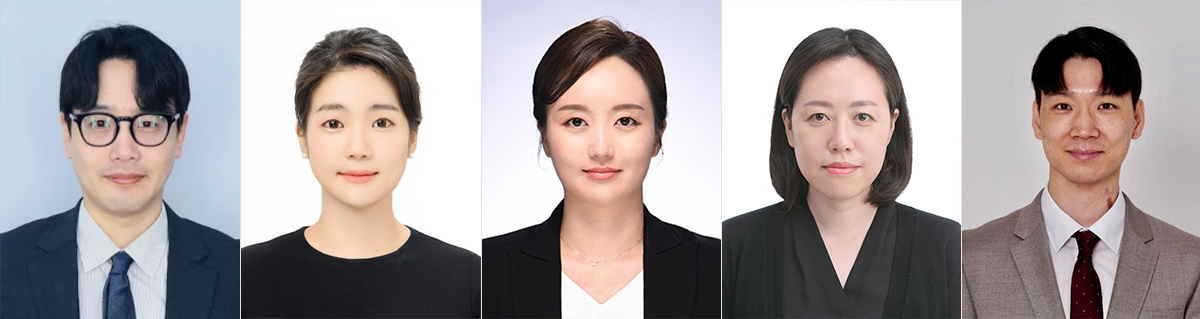
(From left) Professors Sung-eun Kang, Jung-hyun Kim, Ju-kyung Kwon, Ju-yeon Ham, and Tae-hwi Eom—researchers from the Smart Tourism Research Center who have secured faculty appointments at domestic and international universities.
Multidimensional Academic Experience and the Leap to Independent Research
The world-class academic ecosystem established by the center has become a premier incubator for nurturing outstanding scholars. Assistant Professor Sung-eun Kang (Hanyang University ERICA) and Assistant Professor Jung-hyun Kim (University of Central Florida) internalized the core competencies of independent scholars through their experience managing center-led projects, international journals, and academic symposiums. Professor Kang noted, “In an era where an overseas degree alone no longer guarantees a faculty appointment, I was able to build global competitiveness by applying diverse research methodologies to real-world challenges.” Professor Kim described the center as “a practical space that allowed me to define my scholarly role through collaboration with experts in other fields during periods of uncertainty.”The center’s research horizons have expanded through long-term projects that integrate technology and tourism. Assistant Professor Ju-kyung Kwon (Kyungpook National University) and Assistant Professor Ju-yeon Ham (Chosun University) have broadened the scope of the field through their respective work on Metaverse/AI-based tourism and convergence research utilizing Qualitative Comparative Analysis (QCA). Professor Kwon remarked, “Engaging in research closely linked to actual industry shifts allowed me to map out a long-term academic direction.” Professor Ham emphasized that “the exposure to global networks and the exchange of diverse methodologies became the driving force in establishing my unique research identity.” Recently, Dr. Tae-hwi Eom, who was appointed to the Macau University of Science and Technology, demonstrated the strength of the center’s systematic growth model—rising from a BK21 scholar to a research professor. He successfully leveraged his extensive experience presenting at international conferences as a key competitive advantage in securing his global faculty position.
A Global Network of Academic Excellence
The center’s influence extends far beyond Korea, with its alumni securing prestigious faculty positions at leading universities worldwide. Notable appointments include: Professor Sunyoung HLee (Beijing Institute of Technology), Professor Kyoungmin Lee (Shandong University), Professor Hanna Lee (University of New Hampshire), Professor Oh Jeong (Hainan University), and Professor Seunghun Shin (The Hong Kong Polytechnic University). The international impact is further evidenced by researchers such as Joo Young Kim (Copenhagen Business School), Yerin Sarja Lee (American University), and Research Professor Eunji Lee (The Hong Kong Polytechnic University), who are all advancing the frontiers of tourism research on the global stage.Professors Namho Chung and Chulmo Koo, the architects of this academic ecosystem, reflected on the center’s mission: “In an environment where competition intensifies immediately following a doctoral degree, we aim to provide a structured platform for researchers. Our goal is to help them cultivate the qualities of an independent scholar—from publishing in top-tier journals to building global networks and leading large-scale projects.” They added, “The Smart Tourism Research Center is more than just a space for accumulating performance metrics; it is a forward base where scholars establish their academic identities and contribute meaningfully to the global knowledge society.”
- ⓒ경희대학교 커뮤니케이션센터 communication@khu.ac.kr