Academics
Bringing Science Museums to Life with Immersive Media
2026.04.06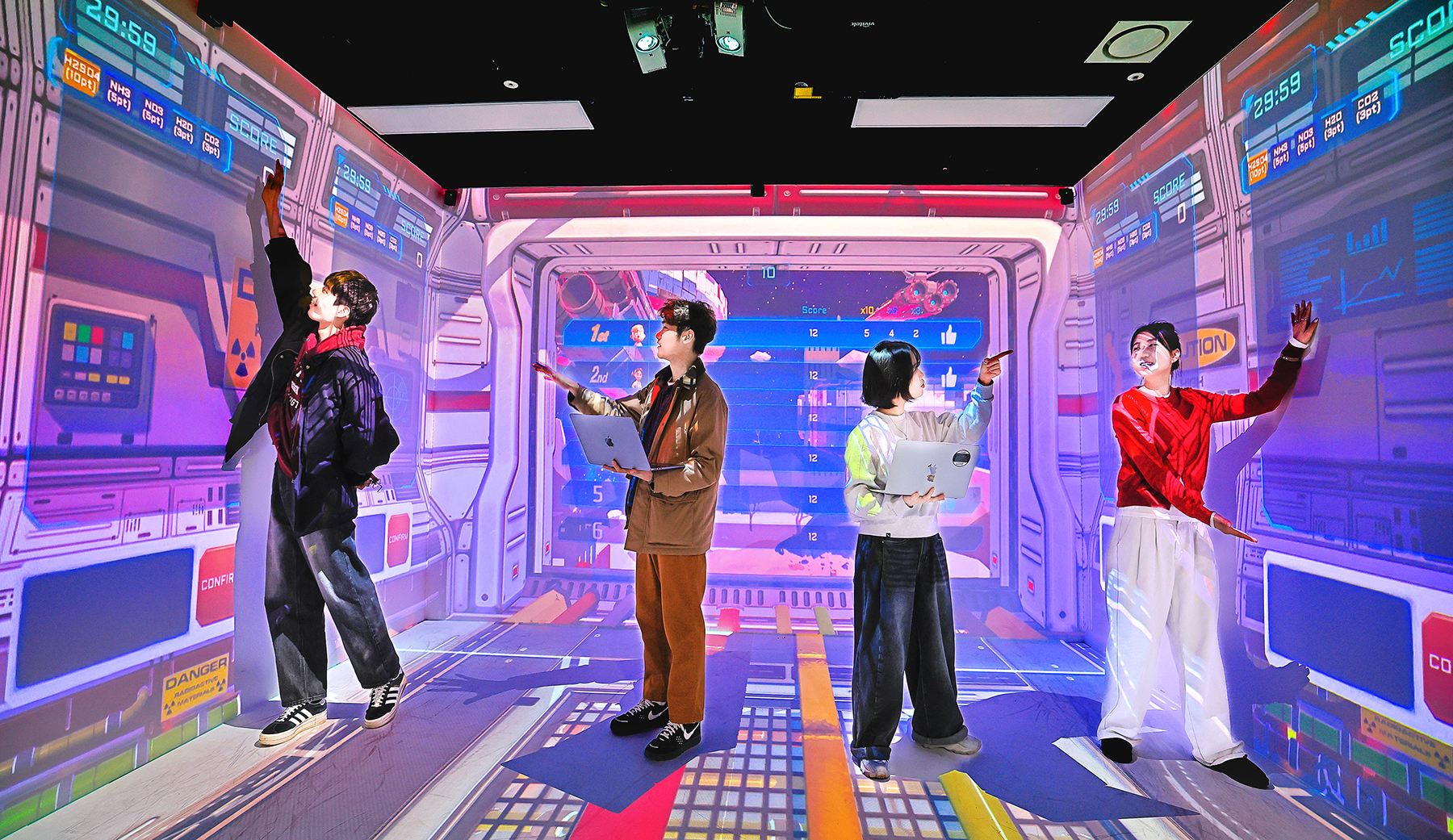
Team “In-cureactive” won the Minister of Education Award at the WE-Meet Project Competition for developing XR-based educational content specifically designed for science museums.
Immersive Media Team Wins Minister of Education Award in WE-Meet Project
Creating Synergy Through Interdisciplinary Collaboration for XR Science Museum Exhibits
The “In-cureactive” team—composed of Sungmin Yoon (Electronic Engineering, ’21), Kihyun Park (Digital Contents, ’21), Yeoni Seo (Theater and Film, ’23) and Sara Lee (Taekwondo, ’23)—has been awarded the Minister of Education Award at the WE-Meet Project Competition. This nationwide industry-academic event is co-hosted by the Ministry of Education and the National Research Foundation of Korea and serves as a flagship program for the College of Immersive Media Innovation Convergence, a part of the Convergence and Open Sharing System (COSS).
The team developed “XR-based Education Content for Science Museums,” a competitive game where visitors create molecules by touching chemical symbols displayed on the walls. The content supports up to six simultaneous participants and features an adaptive interface that recognizes the height of the user’s touch, ensuring a seamless experience for both children and adults.
By utilizing an XR CAVE (Cave Automatic Virtual Environment) system—which integrates the side walls, center screen, and floor—the project offers a fully immersive experience. This innovation effectively transforms static exhibition spaces into dynamic, multi-user edutainment hubs.
Q. How does it feel to receive the Minister of Education Award?
Sungmin Yoon (hereafter Yoon): We didn’t start this project with the specific goal of winning an award. Instead, we focused entirely on identifying user needs and pain points and then finding ways to solve them. Following that logical flow of problem-solving was a deeply rewarding experience, and I think that focus is what ultimately led to this great result.Kihyun Park (hereafter Park): This was my first time experiencing the full, sequential process of a project—from initial use research to problem definition and final design. Receiving this award is especially meaningful because it feels like a validation of that entire journey.
Q. What was the core problem or insight that sparked this project?
Yoon: Since the competition theme was XR-based content development, our discussions led us to focus on science museum exhibition systems. We noticed that while many museums are equipped with high-tech hardware like LiDAR sensors for large-scale displays, visitors often remain passive observers, simply looking at the screens.Sara Lee (hereafter Lee): To address this, we planned interactive content that leverages existing systems while maximizing educational impact. This led us to our final direction: a chemical bonding experience where visitors actively participate to grasp scientific concepts.
Q. What specific problems did you uncover during the user research phase?
Lee: We visited museums in person to conduct surveys and interviews. Through this process, we confirmed that long wait times for experiential content and displays that focused purely on visual effects resulted in low participation. Furthermore, because the primary users are children with varying heights, the existing systems often struggled to accurately recognize their interactions.Yeoni Seo (hereafter Seo): To solve these issues, we designed gamification content that allows users to learn educational material through gameplay. We put a lot of thought into an interface that even young children—our main target audience—could use easily. We also designed the experience to accommodate more participants within a set time limit to significantly reduce the wait times noted during our research.
Q. What challenges did you face during the implementation phase?
Yoon: Since it was everyone’s first time actually developing content using an XR CAVE system, there were definitely hurdles. We received assistance from partner companies for the initial display calibration and touch system setup, and then we built the actual content on top of that foundation.Park: We put a lot of thought into the UX (user experience) design so it would be accessible to all ages, from children to adults. We designed the interface so that element symbols would appear only near the area where a player touches the wall. This allowed interaction to happen naturally regardless of the user’s height.
Lee: We focused on making the content as user-friendly as possible. This involved careful level design to ensure the game wasn’t too difficult. We also worked on the “world-building” aspects—creating a laboratory atmosphere with specific background music, sound effects, and props—to help users feel fully immersed in the experience.
Seo: While the team members didn’t have extensive development experience and all came from different majors, that diversity actually created a greater synergy. We divided roles based on our individual interests and academic backgrounds. Sungmin Yoon handled content development, Kihyun Park managed UX design, Sara Lee took charge of planning, and I used my background in Theater and Film to develop the scenario and narrative.
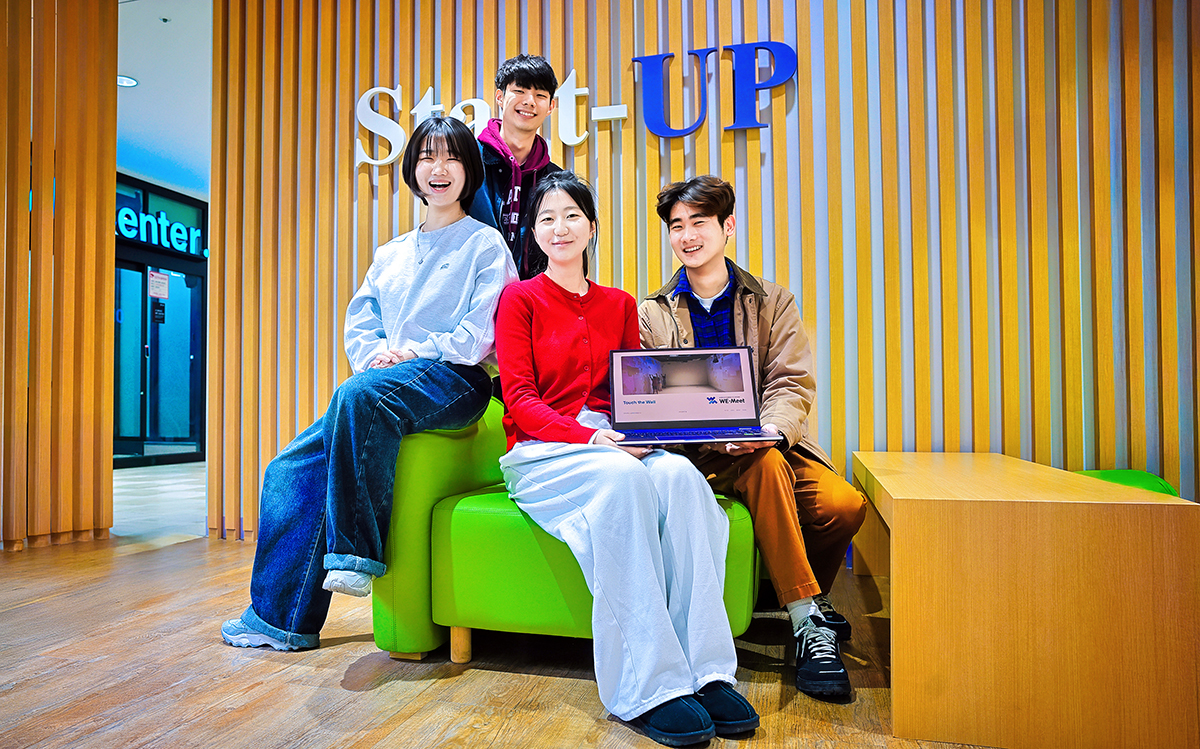
Though each team member pursued the Immersive Media Convergence major for different reasons, they divided their responsibilities to align with their individuals interests.
Q. What sparked your interest in the Immersive Media Convergence major?
Seo: I used to think that theater/film and immersive media were entirely separate fields. However, after taking Professor Tack Woo’s “Introduction to Computer Games” course, I realized there are deep connections between immersive media and cinematic visuals. This naturally led to an interest in XR and AI technologies, prompting me to choose this major. My goal is to combine my Theater and Film major with immersive media to create entirely new types of content.Lee: My interest in game planning grew through my activities in the game development club, “Ludens.” Seeing the process of a plan being transformed into actual content made me think more specifically about my career path. I applied for the Immersive Media Convergence major because it allows me to learn planning, development, and design all at once.
Yoon: I’ve always believed that XR and VR are fields with immense future potential. As hardware and communication technologies rapidly evolve, I wanted to contribute to realizing truly immersive media that transcends current technical barriers, such as limited immersion and low interaction levels.
Park: While studying UX design, I found it fascinating that there are no standardized user experience patterns in XR and AR environments yet. I wanted to take on the challenge of defining how users interact within these new technological landscapes.
Q. What are your goals for the future?
Seo: I want to grow into a convergence-oriented talent who understands planning, development, and design alike. My ultimate goal is to create entirely new forms of content by merging my theater and film background with immersive media.Park: I’ve realized how vital it is to have a broad understanding of technology, design, and even business strategy. I plan to study these fields abroad in the future to gain a wider range of international experience.
Yoon: My goal is work in the R&D of VR and XR devices. I want to develop technologies that enable highly immersive interactions.
Lee: Through this project, I’ve gained certainty in my goal of becoming a game planner. I want to create content that delivers fresh, innovative experiences to users all around the world.
Q. Any words of advice for students considering the Immersive Media Convergence major?
Park: The Convergence and Open Sharing System (COSS) offers an excellent curriculum and a diverse array of practical training content. Through project-centered classes, you can build your real-world content development capabilities. On top of that, there are various programs like credit exchanges with other universities and overseas training opportunities, so you can truly gain as much as you are willing to pursue.- ⓒ경희대학교 커뮤니케이션센터 communication@khu.ac.kr