Professor Jong-Do Park on Helping Students Graduate Without Hating Mathematics
Interview with Kyung Hee Fellow (Education) (2) Professor Jong-Do Park of the Department of Mathematics
Lectures highlight academic connectivity, and learning that continues even after assessment
“Students should not be spectators, but active participants who fill in the gaps themselves.”
Editor’s Note: Kyung Hee selects professors who have shown outstanding achievements in the education and research fields every year as “Kyung Hee Fellows (Research/Education).” The professors selected as Kyung Hee Fellows (Education) practice student-centered education in their respective majors. Professor Jong-Do Park of the Department of Mathematics has led the growth of his students through lectures emphasizing the “connectivity of academic fields,” learning materials bridging online and offline environments, and class operation where learning continues even after assessment. We met Professor Park to hear about his educational philosophy and implementation plans.
2026.07.13
Composing Lectures to Understand the Flow of Mathematics as an Academic Field
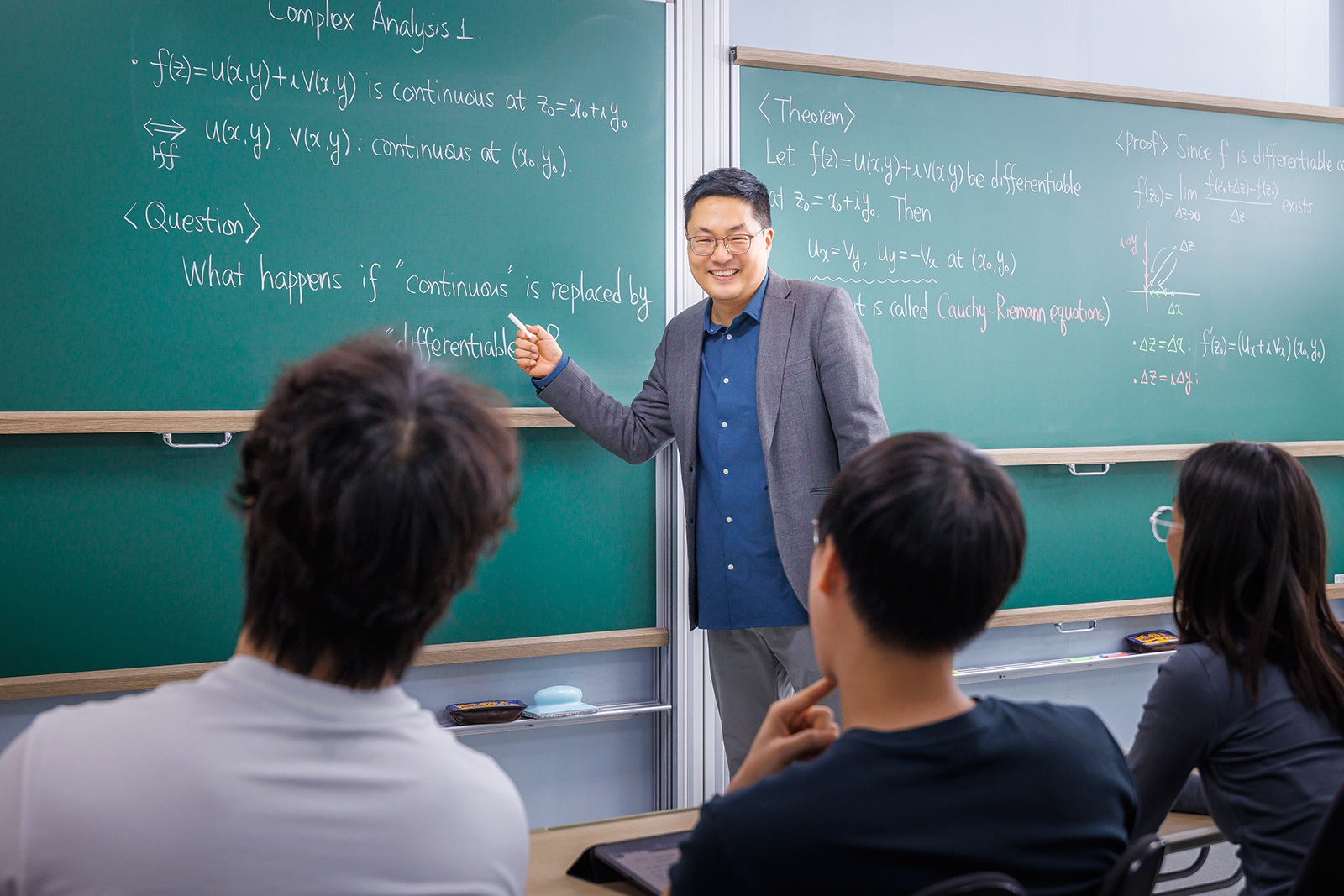
Professor Park views major mathematics as a flow of academic study accumulated over a long period. Most of the content learned during the semester is the result of refinement for over more than a century. He believes that students should understand the connections and developments rather than memorizing individual concepts. Therefore, he emphasizes “academic connectivity” in every lecture.In the first class of a lecture, he explains the big picture of his course by organically binding the content to be learned during the semester. While the lecture progresses, he points out where they are now, what important and difficult concepts they will face soon, and what they need to prepare to understand them. This is out of his desire for students to not just accept organized results, but to follow the flow of thought of mathematicians like Gauss or Euler and see under what problem awareness they created new concepts and methods.
Lectures Enabling Students to Actively Intervene as 'Protagonists'
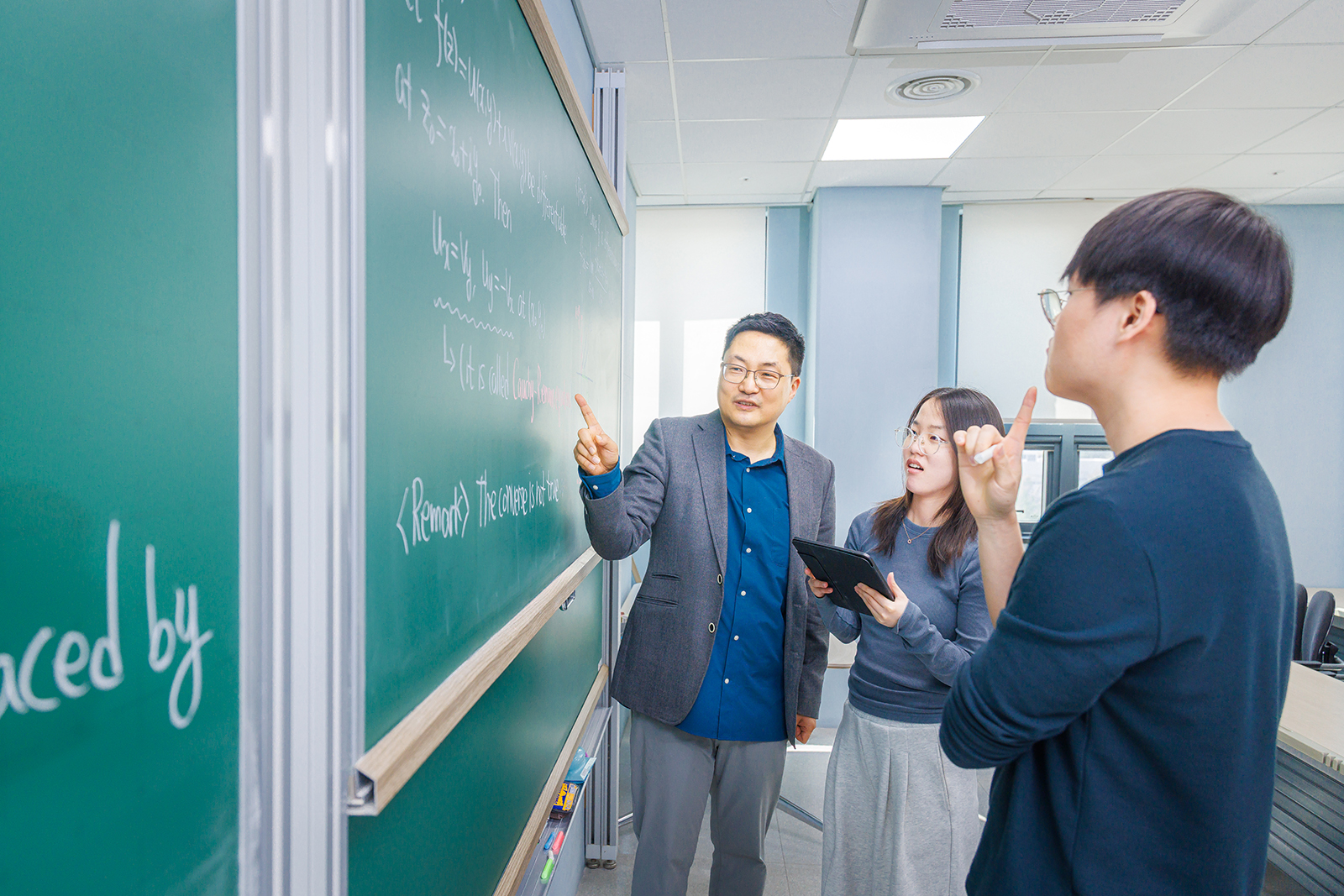
What Professor Park considers most important in class is that students do not remain “spectators” of the lecture but actively intervene to become “protagonists.” He believes that the classical method of explaining while writing on the blackboard with students directly taking notes and reviewing, is still the most effective. This is because students can only truly internalize the content when they follow definitions, theorems, and proof processes with their own hands, rather than just listening.However, he felt that the teaching methods must also change in accordance with the reality that students' learning styles and academic capacities have diversified. The turning point was the pandemic period. Prior to the pandemic, lectures centered on writing on the board and providing PDF materials afterward, but students accustomed to online classes showed different patterns after returning to face-to-face classes. Professor Park said, "Seeing students struggle with face-to-face classes, I felt the need to prepare online learning resources separately from offline lectures."
In line with these changes, Professor Park began composing all lectures in PPT form and recording the lecture content in advance to provide them as videos for preparation and review. The “Kyung Hee Math” YouTube channel (see related link)is also a pillar of class expansion. However, he does not provide completed materials as a whole to students. Prior to the lecture, he provides a fill-in-the-blank document containing only the overall structure, and makes students write in important definitions, theorems, proofs, and calculations during the class. This means that students must think and record on their own while following the flow of the class.
The fact that it is difficult to satisfy all students of various levels within limited lecture times also became the background for video production. Professor Park supplemented content that could not be covered in class with videos, allowing students to selectively utilize them according to their levels and needs. This was based on the judgment that easier explanations could help students with insufficient foundations, while expanded content could benefit those who wish to delve deeper. This approach led to actual changes in learning attitudes. An increasing number of students utilized the video materials, which were expected to be used for review, for preparation instead, and asked questions on points they were curious about during class. He stated, "When I see students continuing their math studies even during vacations or military leave, I feel rewarded as an educator."
The innovation of the digital environment at the university level was also helpful. Professor Park utilizes “ChatKHU,” a generative AI provided on campus, in his classes. He also conducted a class comparing the methods of his students with the methods used by AI. Even if the AI reached the same conclusion, it sometimes showed more complex solution processes or new approaches. This is also an example where the university-wide learning environment opened a new perspective for students to critically review their own mathematical solving processes.
Turning Assessment into Learning
A good assessment in Professor Park's view is not simply a procedure for grading. He states, "It must be a process through which students confirm their deficiencies through exams and can start learning anew." For this purpose, he discloses solutions, grading criteria, and averages for each question after mid-term exams. Students gain the strength to follow subsequent classes through the process of writing incorrect-answer notes and organizing them again.The fairness of assessments is also a principle he values importantly. There are past exam questions commonly referred to as jokbo (exam genealogy), and he believed that students obtaining these past papers caused inequality in learning. Professor Park distributes recent past exam questions and solutions in advance before exams. After the exams, he provides opportunities to read the exam papers. This time is not simply for checking grades. It allows students to find where their logic was broken in their solutions and close the semester by discussing the solution processes with the professor.
Professor Park's assessment of college mathematics is a method that examines the correct answer and the entire solution process. Even if the answer is correct, points can be deducted if the intermediate process is insufficient; conversely, even if the final answer is incorrect, points can be received if the core process is correct. He states, "This method of assessment fosters students' abilities to advance their thought processes without giving up." He emphasizes incorrect-answer notes for the same reason, since it is difficult to follow subsequent content while leaving previous content insufficiently understood.
Exams Solved Alone, Growth Built Together
There are also educational practices that continue outside the classroom. Since 2017, Professor Park has led a group of students preparing for the university student mathematics competition. It began when he felt, during counseling with students dreaming of entering graduate school or wishing to tackle more difficult problems, that a higher goal was needed where they could compete with outstanding students nationwide.The group solves and discusses problems every week. Students present their assigned questions and become facilitators to find solutions. Professor Park tells students, "Do not hide what you do not know." It is natural not to know the answer for everything and true discussions can begin only when students have questions. Going through this process, students grasp each other's strengths and weaknesses and grow together.
As a result, since 2017, more than 10 students have won a total of 20 awards in the Korean Mathematical Society’s University Mathematics Competition, and in 2024, this group produced a gold prize winner, given to the top 5%, for the first time. Professor Park reminds students, "Exams are always an 'individual event' for students, but the process of discussing together and helping each other is a 'team event.'" This is because the experience of discussing the same goal and sharing the joy of problem-solving is more important than winning awards. As a result, the Kyung Hee delegation won the Outstanding Club Award, newly established in 2024, for two consecutive years.
Loving Mathematics to the Very End
Professor Park often delivers the same words to first-year students: "You probably came to the Department of Mathematics because you liked math, and I hope you still love math at the moment of graduation." Mathematics is not simply a skill for solving calculation problems but a discipline for learning logical ways of thinking. While attempting to understand the process of proving important problems from new definitions, students develop the strength to overcome any obstacle.He points to learning experiences accustomed to “finding answers quickly” as one of the reasons students become afraid of math. College mathematics is not study for quickly finding established answers, but is a process of understanding why such theories were made and through what trials and errors they reached their current form. Therefore, rather than all students aiming for perfect grades, he recommends that each student set a goal of what they want to learn in his course and follow it through to the end. He wants to teach students the value of utilizing math as a tool in each student’s individual journey.
This strength remains even if career paths change. Students deeply captivated by the charm of math can enter graduate school to cultivate their dreams as scholars, and students heading to other fields such as finance and engineering can challenge new domains based on the cognitive power raised through math. Professor Park explained, "After graduation, math students advance into various paths such as actuarial science, banking, graduate schools of engineering and economics, and the field of education."
Professor Park is also envisioning a “University Mathematics Competition Homecoming Day” connecting graduate students from the competition group with current undergraduate students. This is because he believes that the voices of those who walked the same path first can serve as realistic guides. Furthermore, he is planning to open lectures that gather and introduce mathematics used in the fields of economics or engineering. Professor Park stated, "In the future, I will continue to help students not to fear math and to discover the vast possibilities of math within their respective career paths."